
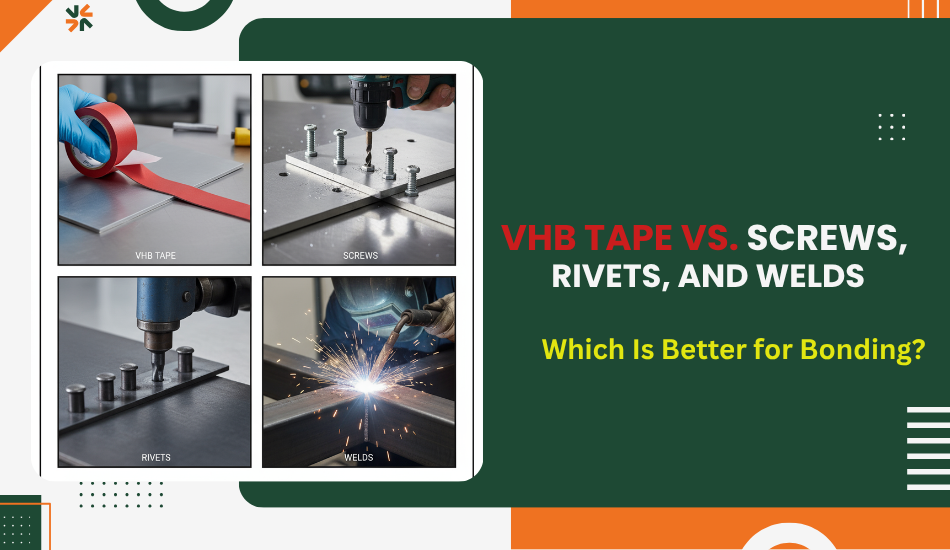
Bonding materials securely is crucial in modern industries like automotive, construction, electronics, and aerospace. The right choice affects not just strength but also durability, weight, and aesthetics.
Choosing between VHB tape and traditional mechanical fasteners—screws, rivets, or welds—can be challenging. Very High Bond (VHB) tape is a strong, double-sided adhesive tape that sticks instantly, handles stress well, and is used in demanding applications where clean, reliable bonding matters.
In this post, we’ll compare VHB tape with traditional mechanical fasteners, explore their advantages and limitations, and guide you on when to choose each method for optimal results.
What Is VHB Tape?
VHB tape is a strong double-sided acrylic tape designed to hold materials together without screws or welding. It sticks to metals, glass, plastics, and composites and distributes stress evenly across the bonded area, which reduces fatigue and prevents failure points.
It’s resistant to UV, moisture, vibration, and temperature changes, making it suitable for indoor and outdoor applications.
Common uses include:
- Automotive panels, trims, and glass
- Construction projects like glass facades and signage
- Electronics assembly for displays and frames
- Aerospace applications for lightweight components
VHB tape eliminates the need for drilling, reduces weight, and creates a clean, seamless appearance—ideal where aesthetics and efficiency matter.
Traditional Mechanical Fasteners: Screws, Rivets, and Welds
- Screws are threaded fasteners that join materials and can be removed if needed.
- Rivets provide permanent fastening, commonly used in aircraft, metal fabrication, and automotive industries.
- Welds fuse metals together, offering very strong, permanent joints.
Advantages:
- Proven strength and reliability
- Suitable for heavy structural applications
- Widely used in industrial and construction sectors
Limitations:
- Require drilling, welding, or skilled labor
- Can create stress points or corrosion
- Add weight to assemblies
- May affect the surface appearance
Key Differences Between VHB Tape and Mechanical Fasteners
Feature |
VHB Tape |
Mechanical Fasteners (Screws, Rivets, Welds) |
|---|---|---|
| Strength & Load Bearing | High shear and tensile strength; distributes load evenly over bonded area | Very high localized strength; may create stress points; better for heavy structural loads |
| Installation & Labor | Quick, clean, no special tools; no drilling or welding required | Labor-intensive; requires drills, welding equipment, or precise alignment |
| Weight & Aesthetics | Adds no extra weight; smooth, clean surface; invisible bond | Adds weight; holes or weld seams visible; may affect aesthetics |
| Vibration & Stress Distribution | Absorbs vibrations; reduces fatigue by spreading stress | Stress concentrated at fastener points; potential cracking or fatigue over time |
| Environmental Resistance | Resistant to UV, moisture, chemicals, and temperature changes | Susceptible to corrosion; welds may require coatings; screws can loosen over time |
| Flexibility & Surface Adaptability | Bonds irregular, curved, or dissimilar surfaces easily | Limited adaptability; surfaces need to be flat and aligned |
| Applications | Lightweight structural bonding, automotive trims, electronics, signage | High-load structures, permanent assemblies, heavy industrial or construction projects |
| Maintenance & Longevity | Long-lasting, minimal maintenance | May require periodic inspection, tightening, or repair |
Industry Applications and Use Cases
- Automotive: Body panels, trims, and glass bonding
- Aerospace: Lightweight components and interior panels
- Construction: Glass facades, signage, cladding
- Electronics: Displays, frames, and assemblies
VHB tape successfully replaces fasteners in many applications where strength requirements are moderate, aesthetics are important, and vibration absorption is needed. Mechanical fasteners remain essential for high-load and critical structural connections.
When to Choose VHB Tape vs. Mechanical Fasteners
Choose VHB tape:
- Lightweight materials
- Smooth, clean appearance
- Vibration absorption
- Indoor or outdoor exposure
Choose mechanical fasteners:
- Heavy, structural loads
- Extreme environmental conditions
- Permanent assemblies
Benefits of VHB Tape Over Screws, Rivets, and Welds
- Clean, fast installation without drilling or welding
- Lightweight and aesthetically pleasing
- Spreads stress, absorbs vibration, reduces fatigue
- Resistant to UV, moisture, and chemicals
- Saves time and maintenance costs
- Bonds irregular or dissimilar surfaces
Conclusion
VHB tape is a modern, efficient alternative to traditional screws, rivets, and welds in many applications. While mechanical fasteners are unmatched for heavy loads and structural integrity, VHB tape provides a lightweight, durable, and aesthetically pleasing solution for medium-load and vibration-prone assemblies.